
Current filter:
Published: 12 December 2025
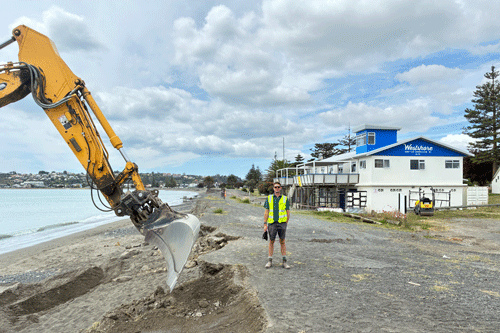
Yesterday’s Hawke's Bay Regional Council Facebook post about the urgent Westshore bund repairs drew a number of questions from the community members. In this explainer, we’ve gathered the main themes from those comments and asked HBRC Coastal Specialist Joao Albuquerque to talk us through what’s happening, why it’s needed, and how decisions are made on a coastline as lively as Westshore.
The work that began today along the Westshore bund is part of an ongoing cycle of coastal care – the sort of maintenance that all energetic, erosion-prone shorelines need from time to time. The late-November heavy seas didn’t create a brand-new problem; they simply exposed the parts of the bund that needed attention first. HBRC has looked after this 750-metre coastal defence line for decades, and this mahi is about restoring its shape, strength and stability so it can keep doing its job of absorbing wave energy.
As we detailed yesterday on our Facebook post, our contractors Everfresh will be placing 170 large concrete blocks to pin the structure in place, locking in about 9000 cubic metres of pea metal – the gravel 'armour' that forms the working face of the bund. Once the material is placed, surveyors will reshape the line to its designed profile: the height, slope and form that gives it strength. The team will work hard through to Christmas on the stretches hit hardest by recent swells, then return in the New Year to complete the rest.
Replenishment of this kind is not a one-off fix; it’s how dynamic coasts are looked after the world over. Beaches erode and rebuild, storm by storm and season by season, and the job of councils – from Hawke’s Bay to the Gold Coast – is to maintain the buffer between people and the sea as safely and cost-effectively as possible. Some residents asked about other approaches – from artificial reefs to seawalls to letting nature “take its course”. Others wanted more detail on cost and longevity.
So, we put those questions – your questions – to HBRC’s coastal specialist, João Albuquerque. Here’s what he told us.
1. What drives the need for ongoing replenishment and reshaping work at the Westshore Bund?
Beaches are dynamic environments that naturally erode and accrete over time. At Westshore – and in many other locations worldwide experiencing chronic erosion – sediment replenishment is a common practice.
Because coastal processes are unpredictable, there’s no such thing as a one-off solution for Westshore or anywhere else. Take the Gold Coast: they’ve just completed a major renourishment after Cyclone Alfred, using dredges and trucked sand to restore their beaches. In fact, those beaches only exist today because of a permanent sediment bypass system that keeps replenishing the sand that drifts away. In simple terms, they use a very expensive pumping system to do what we achieve with trucks and machinery – the practical, affordable option for Westshore right now.
2. How does the combination of pea metal and concrete blocks strengthen the bund – and why is this a sensible, cost-effective approach for an exposed coastline like Westshore?
In places where there is not enough space to build the bund as per design, we use concrete blocks along the landward side to provide support against wave action and stop the bund from being push backward. We also place blocks at the transition between narrower and wider sections of the bund, helping the wider end hold its intended shape.
In terms of cost, we continually assess alternative products and systems. To date, this combination of pea metal and concrete blocks has been the most reliable and affordable option for Westshore.
3. What alternative options – such as artificial reefs, large seawalls, or offshore structures – have been explored, and why aren’t they the first cab off the rank here?
All the major alternatives have been explored.
Seawalls are extremely expensive to build and maintain, and they create strong “end effects” – accelerated erosion immediately beside the wall’s edges. They also don’t solve the underlying erosion problem: the beach would continue to shrink until there is no beach left and wall itself was exposed to waves. We recently assessed a new modular protection system, but the costs remain very high for essentially the same outcome.
Artificial reefs were investigated back in 2001 by ASR in a report that proposed a 12,250m³ structure off Westshore – roughly the volume of 17,000 of the concrete blocks used in the current repairs. Artificial reefs are costly (up to four times the price of a coastal structure) and come with real risks. The projects at Opunake and Mount Maunganui more than doubled their estimated budgets, failed to perform as intended, and, at the Mount, generated dangerous rip currents. Similar issues have occurred at Boscombe (UK), Kovalam (India), and Qamea (Fiji). While more reefs have been built overseas in recent years, few have yet proven successful over the long term.
Renourishment with dredged sand from the port channel is another potential option, but the costs of build a beach are about three times what we’ve spent over the 39 years of our renourishment programme, while the cost of maintaining such a beach would be triple our current spend. Moreover, there’s no guarantee the sand would remain in place.
4. How has the coastline changed over the decades, and how does this natural movement influence the type of interventions that make sense today?
Westshore is a very unique beach, shaped by both its geological history and human modification. It used to be a shingle spit reaching up to the Esk River mouth until the Ahuriri channel was built in the 1800s – and even then, ongoing erosion was being reported. The 1931 earthquake uplifted the land and seabed, temporarily masking that erosion and creating a sandy beach that lasted for several decades until the underlying processes became visible again around 1970.
Today, we understand Westshore’s erosion is a combination of currents, wave action and sediment transport. Coarser sediment tends to drift northward, while finer sediment is more easily carried offshore by prevailing currents.
Based on what we've observed and analysed over the years, we know the gravel bund remains the most appropriate solution: it is relatively cost-effective and its behaviour aligns with the way coarse sediment naturally moves in this part of the coast. However, that does not mean we are not constantly looking into other possibilities to improve our coastal resilience.
5. How does HBRC decide when and where to invest in maintenance work like this – and what does this specific project cost?
This is an ongoing collaboration between NCC and HBRC, and there is an annual schedule for its maintenance. However, when high tides combine with energetic seas, additional emergency repair work is sometimes required.
Costs vary from year to year, but this round of repairs is expected to cost around $250,000. While that may seem like a lot of money, it remains far more affordable – and carries far less risk – that the alternative coastal protection options explored to date.
6. How long will this round of repairs last, and what does the future maintenance rhythm look like for Westshore?
Our current programme allows for two renourishment campaigns each financial year, and that’s generally how long we expect the bund to hold its shape. In calmer periods it can last longer, but everything depends on sea conditions. For example, last year we had two separate storm events that triggered emergency works on top of the planned maintenance.
7. How will HBRC continue working with the Westshore community – including updates on progress, beach access, and opportunities for face-to-face kōrero?
We’ve been working closely with the Westshore Residents’ Association, as well as with individual residents through the Clifton to Tangoio Coastal Hazards Strategy process. This will continue throughout the current repair programme.
We’ll provide regular public updates and keep residents informed about our ongoing mahi.
+64 6 835 9200
159 Dalton Street. Napier 4110
Private Bag 6006, Napier 4142
Disclaimers, Copyright & Privacy


Disclaimers and Copyright
While every endeavour has been taken by the Hawke's Bay Regional Council to ensure that the information on this website is
accurate and up to date, Hawke's Bay Regional Council shall not be liable for any loss suffered through the use, directly or indirectly, of information on this website. Information contained has been assembled in good faith.
Some of the information available in this site is from the New Zealand Public domain and supplied by relevant
government agencies. Hawke's Bay Regional Council cannot accept any liability for its accuracy or content.
Portions of the information and material on this site, including data, pages, documents, online
graphics and images are protected by copyright, unless specifically notified to the contrary. Externally sourced
information or material is copyright to the respective provider.
© Hawke's Bay Regional Council - www.hbrc.govt.nz / +64 6 835 9200 / info@hbrc.govt.nz