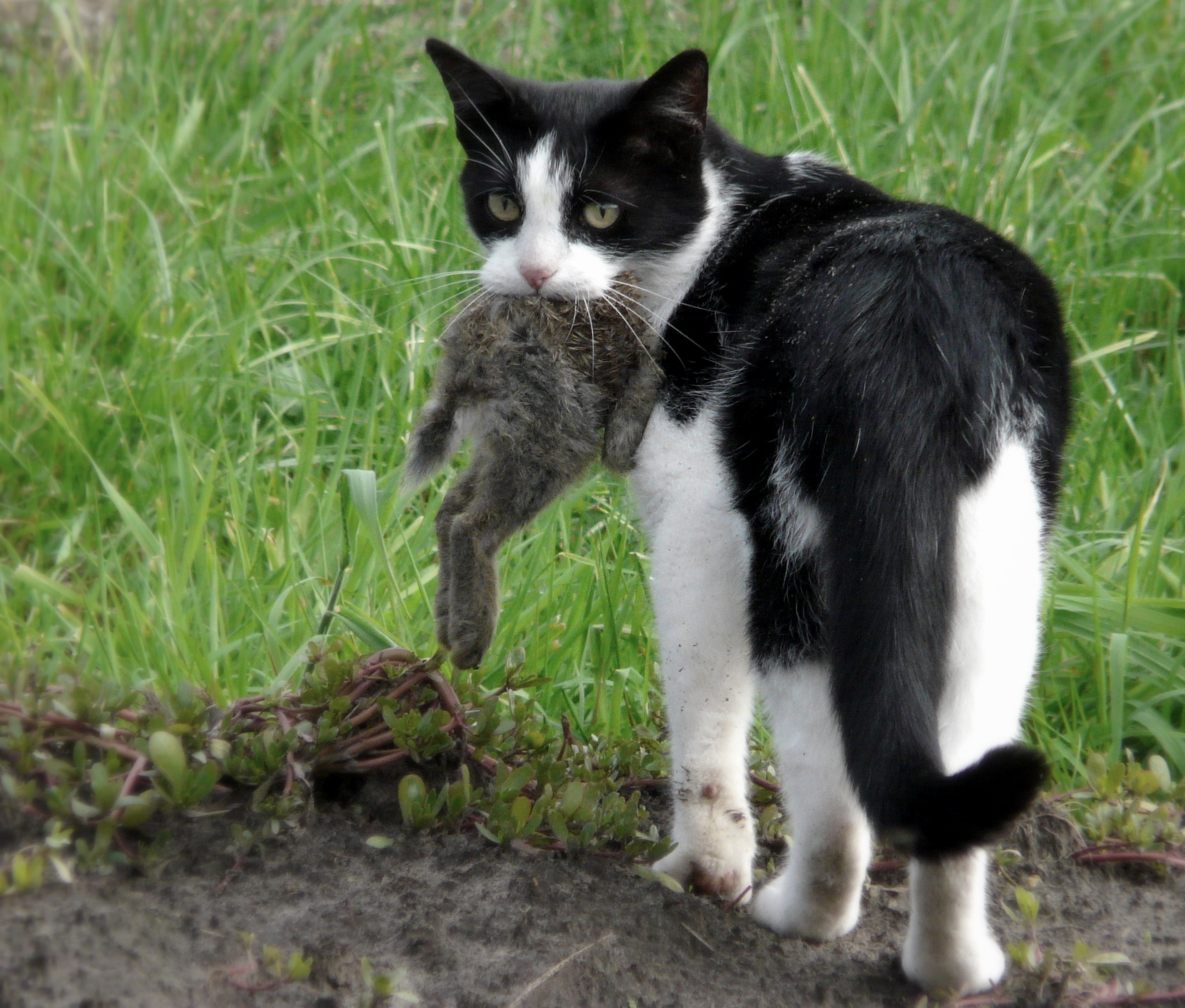
What does it look like?
Feral cats originate from domesticated cats. Although they resemble domestic cats in both size and colouration, they are usually short-haired and slightly built, with a large head and sharp features. Coat colours vary from pure black to orange tabby and some resemble the striped dark and pale grey of the true European wild cat. They commonly revert to black, tabby, or tortoiseshell, with various extents of white.
Adult male cats are usually larger than the females and can weigh up to 5kg. Cats are prolific breeders. Females usually take 6 - 9 months to reach sexual maturity but kittens as young as 4 months can become pregnant. Feral cats can produce 2-3 litters per year with an average of 4 young in each.
Territory is marked by scent secreted from anal glands and by spraying urine. Feral cats are mainly active at night. Their vision and hearing are highly acute, and they avoid contact with humans. Feral cats tend to be more solitary and territorial, whereas domestic, stray, or unwanted cats are more likely to form colonies. Cats can be found in most terrestrial habitats, including urban areas, production landscapes (e.g. farms and orchards) and natural areas (e.g. forests, dunes and wetlands) from sea level to alpine.
Why is it a problem?
Cats are generalist predators and can have large home ranges. Domestic, stray and feral cats are responsible for killing millions of birds, bats, reptiles, and native invertebrates across New Zealand each year. Cats will prey on both young and adult birds and occasionally take eggs. They also prey on native lizards, fish, frogs, and large invertebrates.
Feral cats are implicated (in a small way) in the spread of bovine tuberculosis, with the potential to infect cattle. They also carry parasites and toxoplasmosis that causes abortions in sheep, illness in humans, and has been discovered to infect to endemic New Zealand dolphins.
Feral and stray cats can be aggressive towards pet cats. Stray cats are likely to interbreed with the un-neutered domestic cat population and may spread infectious diseases.
Control methods
Control options include live capture or kill traps. When trapping for pest cats, you need to be careful to avoid trapping domestic cats. Live capture traps include any secure box or trap that is safe to use around residential areas.
Legal requirements: A person who, for the purpose of capturing alive, a mammal, bird, reptile, or amphibian, sets a trap or causes a trap to be set must inspect the trap, or cause a competent person to inspect that trap, within 12 hours after sunrise on each day the trap remains set, beginning on the day immediately after the day on which the trap is set.
Kill traps can be used in a variety of situations outside of residential areas. NAWAC (National Animal Welfare Advisory Committee) approved kill traps are the Timms or the SA2 or (Steve Allan traps). Bait the trap with meat-based baits.
Feral cats can be very difficult to trap as they are naturally cautious, and a previous bad experience will make them shy. Sometimes it’s best to fix the door open for two or three nights until the cat is comfortable entering the trap, before actually setting it. Do not attempt to touch or pick up a feral cat, or even a kitten. They bite and scratch and can spread disease. See a doctor if you get bitten by a feral cat.
Contact us for more information on 0800 108 838.
More information
We support feral cat control within site-led programmes as part of an integrated management approach, aiming to reduce their impact to levels that protect the biodiversity values of these areas.
If a cat is caught and taken to the SPCA for a micro-chip check, they can only do so if it is a "socialised" or domestic cat. Feral cats can be very aggressive and difficult to handle. The scan check is free.
Un-microchipped cats brought to the SPCA cannot be de-sexed without first being released for a week with a paper "lost cat" collar. This is to give their legal owner an opportunity to find the cat again. If it is caught again, it can be de-sexed and released, although this is unlikely to be an option with a cat of a feral nature.
If a social or domestic cat needs to be removed from an area, the SPCA may assist with re-homing it. Very sick or injured cats brought to the SPCA may be euthanised by a vet in some cases, without charge. Note that the SPCA is largely volunteer run and services available may be limited or subject to change.
Our Biosecurity Advisors can guide rural occupiers on effective cat control techniques.
Related links

Management Programme
Site-led Pest Programme
Pests listed under the site-led programmes, and most of the other pests included in the RPMP, are capable of damaging habitats and important ecosystem processes, or competing with indigenous species for food, or prey directly on native species. Pest management, habitat protection (e.g. via fencing) and habitat restoration/creation (e.g. via planting) are key management measures in halting biodiversity decline in Hawkes Bay. A site-led management programme significantly assists with the delivery of each of these goals.
More informationSustained Control Programme
Sustained Control exists to hold well-established pests at an acceptable maximum. However, the costs of management and control grow in-step with the size of the invasive population. Because cost:benefit returns can fall to 1:5 or less, most of this work is focused on specific sites of high ecological value. While the spread of these pests between neighbouring properties remains the predominant risk, in some cases control within properties is still sought and warranted. A sustained control programme will hold populations to maximum acceptable limits over the period of the RPMP.
More informationRules
Plan Rule 16
All occupiers within a Predator Control Area shall maintain ferrets, stoats, weasels, and feral cats in accordance with the Hawke's Bay Regional Predator Control Technical Protocol (PN 4970)
More informationTaxonomies
FamilyFelidae
TypeAnimals
GroupMammal
HabitatLand
Management ProgrammeSite-led Pest ProgrammeSustained Control Programme
RulesPlan Rule 16