
Current filter:
Published: 24 November 2025
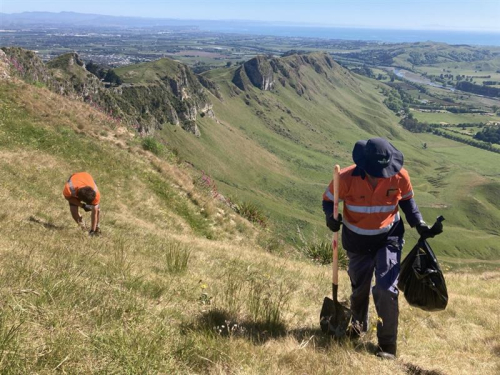
Chilean needle grass, a highly invasive pest plant, has been discovered on Te Mata Peak, prompting a quick response from Te Mata Park Trust and the Hawke’s Bay Regional Council.
Classified as a ‘sustained control pest’ under the Hawke’s Bay Regional Pest Management Plan, Chilean needle grass poses a serious threat to agriculture, the environment, and the regional economy.
Te Mata Park caretakers removed the plants, and Regional Council staff carried out targeted spraying to ensure the pest was controlled at the known location. The area will continue to be closely monitored for any signs of regrowth.
Hawke’s Bay Regional Council Biosecurity Team Lead Matt Short says the Regional Council has a regional leadership role in biosecurity and are committed to protecting areas free of Chilean needle grass.
“Our biosecurity team is actively surveying known sites, implementing a regional control programme, and working with landowners to contain infestations,” says Mr Short. “We’re focused on containing Chilean needle grass, but success depends on partnership with the community – we need landowners to stay vigilant and report any sightings to us.”
Mr Short says the discovery at Te Mata Peak shows how easily the pest can spread.
“Finding Chilean needle grass in an isolated area on Te Mata Peak shows just how easily the seeds spread, sprouting wherever they land. They can spread on contaminated vehicles, personal equipment such as boots or gaiters, stock feed and livestock, so we’re asking landowners to be cautious.”
He adds that now is the ideal time for landowners to check their properties for signs of the pest.
Most Chilean needle grass plants set seed in November and December, when their tall, upright stems produce drooping purple seed heads with long, twisted awns or tails. As summer progresses, the plants turn straw-coloured and blend in with other grasses, making them much harder to identify.”
Chilean needle grass has sharp, needle-like seeds that cling to animals, vehicles, machinery, clothing, and hay. These barbed seeds can pierce the eyes and skin of livestock and reduce the quality of wool, hides, and meat. Once established, the pest spreads rapidly, displacing productive pasture species and lowering feed quality.
How landowners can help:
Inspect paddocks regularly through November and December when seed heads are visible.
Learn the signs - look for tall, drooping plants with purple seed heads that turn straw-coloured later in summer.
Clean vehicles, machinery, and tools after working in or near infested areas.
Avoid moving hay or stock from known infested properties.
Report any suspected infestations immediately to the Regional Council Biosecurity Team on 06 835 9200.
Visit our Pest Hub to learn how you can help identify and manage Chilean needle grass.
+64 6 835 9200
159 Dalton Street. Napier 4110
Private Bag 6006, Napier 4142
Disclaimers, Copyright & Privacy


Disclaimers and Copyright
While every endeavour has been taken by the Hawke's Bay Regional Council to ensure that the information on this website is
accurate and up to date, Hawke's Bay Regional Council shall not be liable for any loss suffered through the use, directly or indirectly, of information on this website. Information contained has been assembled in good faith.
Some of the information available in this site is from the New Zealand Public domain and supplied by relevant
government agencies. Hawke's Bay Regional Council cannot accept any liability for its accuracy or content.
Portions of the information and material on this site, including data, pages, documents, online
graphics and images are protected by copyright, unless specifically notified to the contrary. Externally sourced
information or material is copyright to the respective provider.
© Hawke's Bay Regional Council - www.hbrc.govt.nz / +64 6 835 9200 / info@hbrc.govt.nz