
Current filter:
Published: 24 December 2025
Hawke’s Bay Regional Council is urging people to take extra care around rivers and streams this summer, as hot, dry weather increases the likelihood of toxic algae outbreaks.
With river flows sluggish across many parts of Hawke’s Bay, algal blooms can appear and spread quickly, posing a serious health risk to both people and animals.
So far in December, Regional Council has confirmed two potentially toxic algal blooms caused by the mat-forming cyanobacteria Microcoleus along the Tukituki River – at Walker Road and near the SH2 Bridge in Waipukurau – and more blooms are possible over the next couple of months.
Regional Council environmental scientist Dr Andrea Glockner says water conditions can change quickly during hot, stable spells.
“With our rivers running low and slow, it’s the ideal environment for these toxic algae to spread. We’re asking people to be cautious around shallow and slow-moving water this summer, especially if they have children or dogs with them, as they are more likely to come into contact with, or accidentally ingest the mats.”
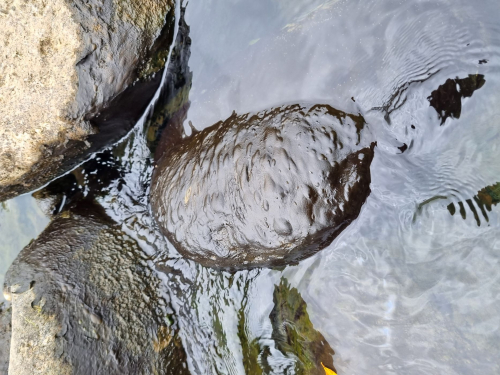
Toxic algae is the common name for potentially toxic growths of algae and cyanobacteria. There are many types, but in this case, the concern is the mat-forming cyanobacteria Microcoleus. It grows as dark brown to black mats attached to rocks on the riverbed. These mats can detach, wash onto riverbanks, and appear light brown or white once dried. Toxic algae can also form blooms in lakes and still water, turning the water into a ‘pea soup’ that discolours the water. Algae occur naturally in water ecosystems, but some can be potentially toxic and cause problems when their numbers climb rapidly.
For dogs, the stakes are high. They are especially vulnerable because they are drawn to the musty smell of algal mats and may sniff, lick, or ingest them. Even small amounts can cause severe illness and may be fatal. Signs of toxic algae poisoning present like heat stress and include lethargy, muscle tremors, rapid breathing, paralysis, or convulsions. Dog owners should seek immediate veterinary care if exposure is suspected.
Small children are also at higher risk as they are more likely to play in the shallows and put algae in their mouths.
Regional Council runs a summer monitoring programme with weekly testing across 37 sites in Hawke’s Bay. Some of these sites, where we know algal growth is a common occurrence during summer, are also monitored for the presence of the potentially toxic algae Microcoleus. All test results are then shared with Land, Air, Water Aotearoa (LAWA) – a national hub for environmental data and information – so people can check the latest status and make informed decisions on where to swim.
Regional Council is asking anyone who sees suspicious algae – particularly at popular swimming or dog-walking sites – to report it through LAWA’s online tool.
Regional Council Chair Sophie Siers says the message is simple: keep enjoying the region’s rivers and lakes but be ready to change plans if the water doesn’t look right.
“Hawke’s Bay summers are made for rivers and lakes,” Chair Siers says, “but this year we’re asking people to be a little cautious. Check LAWA before you go, look out for warning signs, and if the water looks suspect, choose another spot – especially if you’ve got a dog in tow.”
+64 6 835 9200
159 Dalton Street. Napier 4110
Private Bag 6006, Napier 4142
Disclaimers, Copyright & Privacy


Disclaimers and Copyright
While every endeavour has been taken by the Hawke's Bay Regional Council to ensure that the information on this website is
accurate and up to date, Hawke's Bay Regional Council shall not be liable for any loss suffered through the use, directly or indirectly, of information on this website. Information contained has been assembled in good faith.
Some of the information available in this site is from the New Zealand Public domain and supplied by relevant
government agencies. Hawke's Bay Regional Council cannot accept any liability for its accuracy or content.
Portions of the information and material on this site, including data, pages, documents, online
graphics and images are protected by copyright, unless specifically notified to the contrary. Externally sourced
information or material is copyright to the respective provider.
© Hawke's Bay Regional Council - www.hbrc.govt.nz / +64 6 835 9200 / info@hbrc.govt.nz